

Local
Install Dynamic Apps and run it locally while you build.
22 MB of memory while serving, zero while idle. Deploy on any cloud. Supports frontends, REST APIs, multiplayer, SQLite, workflows, and more.
Generate
An LLM writes the files
await deployApp({
  appId: "pied-piper",
  files,
});
Deploy
One call from your code
Route
Live on your domain
A library, not a platform. It serves the apps your users generate alongside the rest of your API, so you keep full control over routing, auth, and data.
Address each app by ID. Every user, tenant, or session gets a deployment of its own.
Each app runs in its own agentOS VM. Tenants share no filesystem, memory, or crashes.
A running app takes 22 MB of memory. An idle one takes none.
Powered by agentOS with a secure Node.js runtime, so generated apps can use any npm package.
Generate
An LLM writes the app as a set of files. Any model, any framework.
import { anthropic } from "@ai-sdk/anthropic";
import { generateObject } from "ai";
import { z } from "zod";

const { object } = await generateObject({
  model: anthropic("claude-sonnet-5"),
  schema: z.object({ files: z.record(z.string(), z.string()) }),
  prompt: "Build a team board as a complete web app.",
});
Deploy
One call builds the files and releases them as an isolated instance.
import { deployApp } from "@rivet-dev/dynamic-apps";

await deployApp({
  appId: "pied-piper",
  files: object.files,
});
Route
Your Hono server serves every deployed app at /apps/:appId.
import { serve } from "@hono/node-server";
import { appsRouter } from "@rivet-dev/dynamic-apps";
import { Hono } from "hono";

const server = new Hono();
server.route("/apps", appsRouter);

serve({ fetch: server.fetch, port: 3000 });Every generated app gets durable SQLite, background jobs, cron, and realtime out of the box. Nothing extra for you to provision.
Requests reach your Node.js backend first, so your routing, middleware, and auth apply. The apps router then hands each request to the agentOS VM running that app, in the same process. No extra hop.
Read about routing, authentication, and deploying apps.
Your Node.js backend
A failed build returns TypeScript diagnostics the agent uses to repair the files and deploy again. The active release keeps serving the whole time.
Read about deploying apps or view the AI App Builder example.
Every app builds and serves inside its own agentOS sandbox: a V8 isolate for the JavaScript, WebAssembly for the Linux-like environment around it. The same boundary applies while a build runs and while requests are served.
Read about the agentOS security model and resource limits.
Your Node.js backend
Deployed apps run as Rivet Actors, so the dashboard shows their data, jobs, events, and actions live.
Browse and query each app's SQLite data in realtime, across every deployment.
Inspect the progress, steps, and retries of jobs running inside an app.
Follow actions, connection events, and application logs while an app serves traffic.
Debug a live app by calling its actions and subscribing to its events from the dashboard.
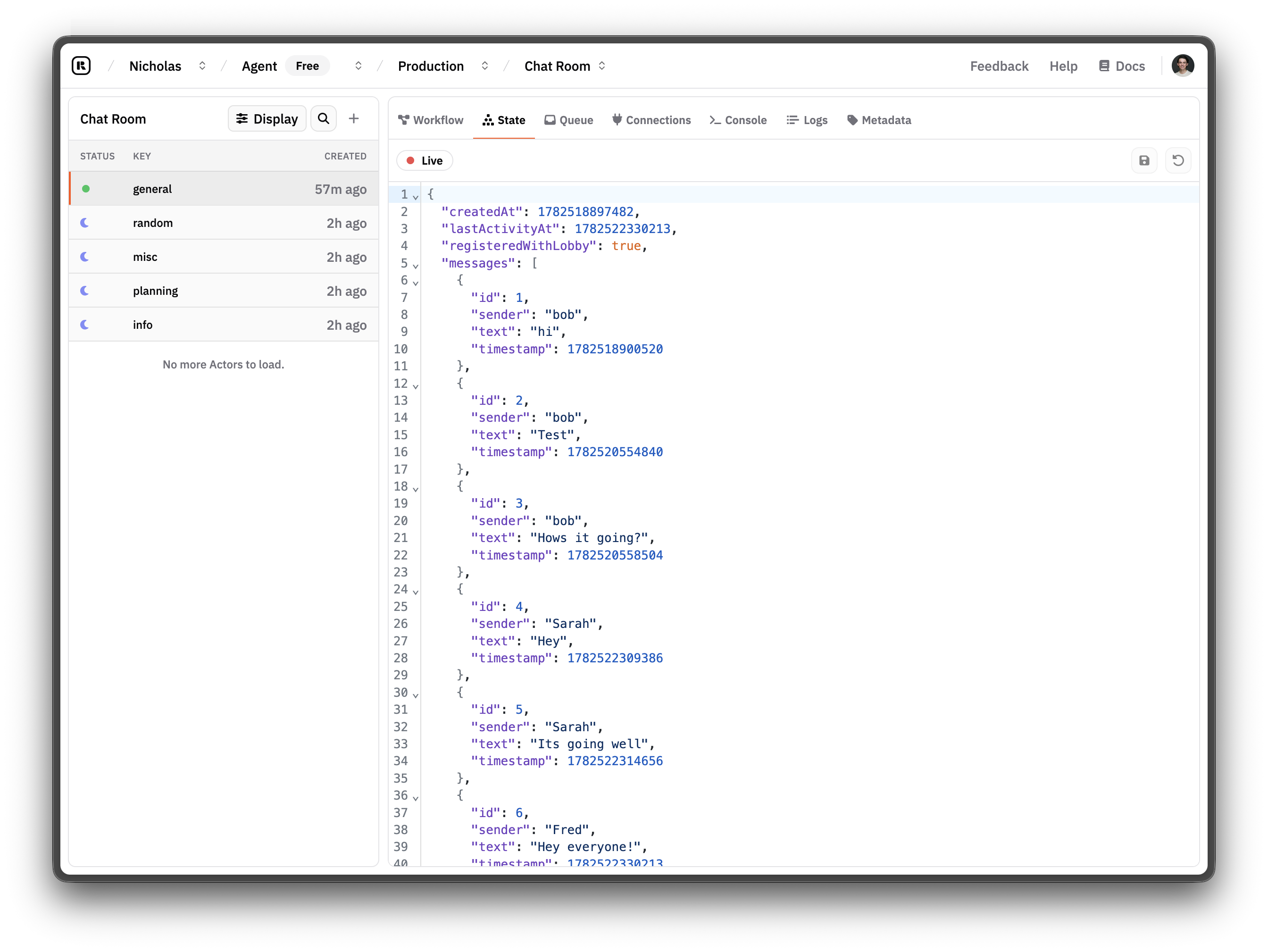
Every deployed app runs as Rivet Actors, which provide identity, durable state, queues, and scale to zero.
Product overviewBuilds and serves each app in an agentOS VM with files, processes, and networking.
Product overviewAdds recorded steps, retries, and replay when a generated app runs multi-step work.
Product overviewDynamic Apps is a library, not a hosted platform. Run it anywhere and customize the server, routing, authentication, and deployment flow.
Install Dynamic Apps and run it locally while you build.
Deploy Dynamic Apps on Rivet Cloud with managed infrastructure and persisted Actor data.
Open the dashboardRun the open-source Rivet control plane as a Rust binary or container on your infrastructure.
Read self-hosting docsDeploy isolated, durable instances for the software your agents generate. They scale to zero and wake on demand.